Julio Huamán
The content of this news item has been machine translated and may contain some inaccuracies with respect to the original content published in Spanish.
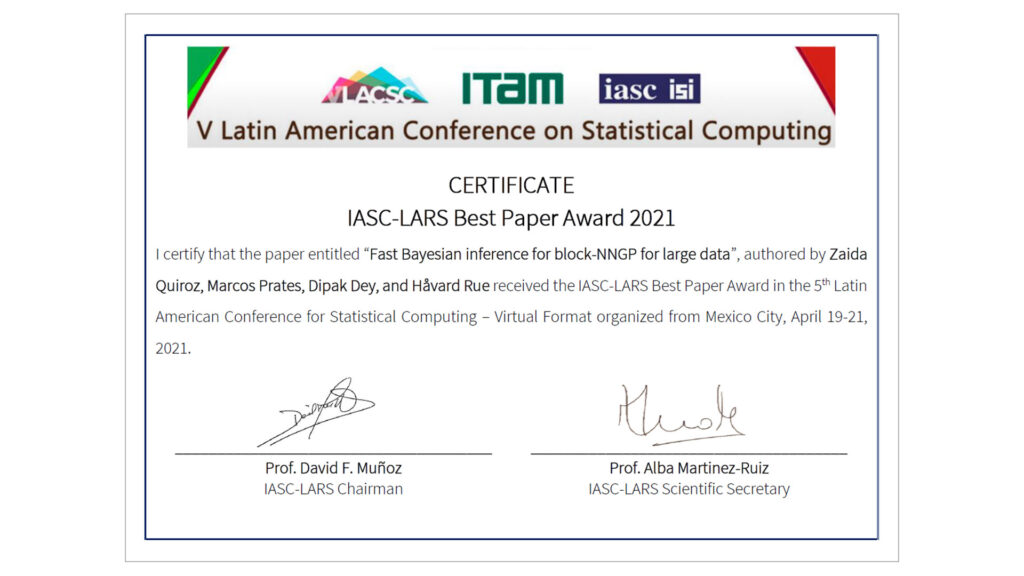
"Fast Bayesian inference for block-NNGP for large data" is the scientific article with which Dr. Zaida Quiroz, a lecturer in our Department of Science, won the award for Best Paper at the V Latin American Conference on Statistical Computing (LACSC 2021). The scientists Marcos Prates, Dipak Dey and Havard Rue worked with her, who were a fundamental part of this work.
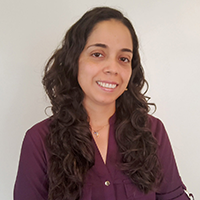
Lecturer and researcher at the Department of Science
Bayesian inference is statistical inference where evidence is used to try to prove that a hypothesis is true. It stems from Thomas Bayes' theorem and its frequent use during the process of deduction. It is therefore of substantial relevance in the field of statistics.
"I work with spatial statistics. It's a bit strange, you don't hear it much in Peru, but it's an area where we study objects, like maps, which can have different types of data, whether it's regions or geolocation, latitude, longitude, etc.," says Dr. Quiroz.
It is as a result of his work and his PhD thesis that he was able to develop, from theory and with practical effects, an improved system for studying patterns in space. This in turn can help various disciplines, such as geology or mining. In such cases, for example, this model can be used to locate terrain with some kind of mineral concentration. In the same logic, an expert could collect and work with data on rainfall, health or environment.
"When you're working with that kind of data, it's usually collected with GPS and it's a lot of information. Big data can be complicated to handle. The idea was to work with these spatial statistical models but to adapt them so that they can work when you have about 10,000 pieces of data. Many of the statistical models that already exist cannot be used when you have this amount of information, as they normally work with 1,000 data," explains our teacher.
Since 2016, Dr. Zaida Quiroz has been working on this research, as mentioned, for her PhD thesis. Then, due to a stay in the United States at the University of Connecticut for seven months, she was able to complement the theoretical part of the model that she had already worked on previously, thanks also to her co-authors. He also spent a month at King Abdullah University of Science and Technology in Saudi Arabia.
"A strength of this paper that has been instrumental in winning the competition has been the computational statistics. This becomes a part of inference using a method that is quite new. A model that runs in three weeks or a month because of the amount of data; with our model, you get it in hours. Really, the contribution in computational terms has been very strong," she says.
If you liked this article, you may be interested in learning more about the PUCP Statistics Specialisation. This science makes sense of data, providing the theory and methods to extract information from it and solve real-world problems.
Thus, statistics are used to support decision-making within governments, political parties, financial companies, public opinion firms, insurance companies, banks, hospitals, social organisations and industries.
.jpg)